

Is it true that injectable GHK-Cu works better than the serum version? No, and this is the single most important thing to know before you buy anything. The evidence for GHK-Cu is strongest as a topical, skin-surface ingredient. The jump to injecting it for whole-body anti-aging is a much bigger leap than your feed is making it sound, and it is a leap the science does not really back yet.
If you have noticed copper peptides taking over your timeline lately, you are not imagining it. GHK-Cu serums are selling out, “glow” content will not quit, and somewhere in there a video is telling you the real results come from a needle, not a dropper. Skin and anti-aging is already the second-biggest reason women land in the peptides category (right behind low desire), so a renewed wave of hype around GHK-Cu is pulling a lot of people toward sellers who are not quite what they look like.
This is a buyer’s guide for that exact moment: what the science on the skin peptides really shows, what the trend gets wrong, and a ranked, plain answer to “okay, so where do I actually get this.”
What changed, and why does it push people toward sketchy sellers?
Nothing changed in the lab. What changed is attention. GHK-Cu has been a respected cosmetic ingredient for years, but a fresh round of social content reframed it as an anti-aging shortcut, and that reframing quietly redirects the shopping list. Someone sets out wanting a better serum and ends up browsing injectable vials labeled “research use only,” because a stranger online insisted the real magic happens under the skin, not on top of it.


That is the trap. The same handful of websites selling the serum-grade story are also selling the injectable, and the distance between a topical cosmetic and an injected compound is far larger than the content lets on. Before following the hype past that line, it helps to know exactly where the actual evidence stops.
Does GHK-Cu actually work, and where does the proof run out?
GHK-Cu, the copper-binding tripeptide at the center of all this, does have real research behind it, just not the research the injectable crowd implies. The foundational review on it describes a naturally occurring molecule that binds copper and drives skin remodeling: stimulating collagen and glycosaminoglycan production, supporting wound repair, and, in cosmetic studies, improving skin laxity, elasticity, and the look of fine lines [3]. That same review notes the body’s own GHK levels drop with age, from roughly 200 ng/mL around age 20 to about 80 ng/mL by age 60 [3].
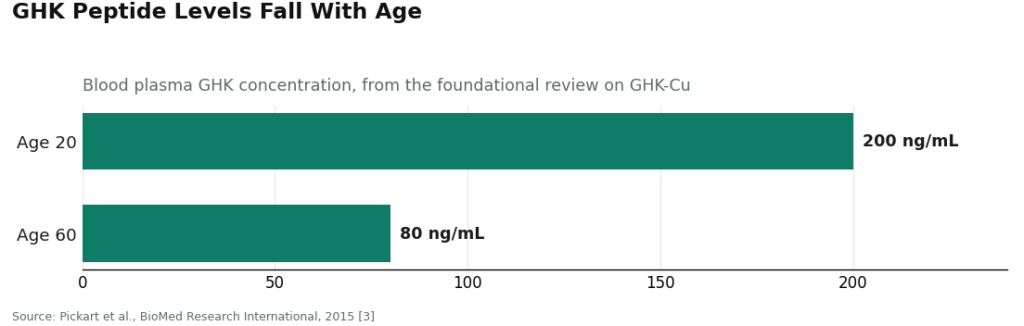
Here is the boundary that matters. That evidence is strongest for GHK-Cu applied topically, and much of it is mechanistic rather than drawn from large clinical trials. A foundational review like this one is written to map out a peptide’s potential, not to sign off on injecting it. So a serum with GHK-Cu is a legitimate, generally well-tolerated skin-care ingredient with reasonable science behind it. Injectable GHK-Cu marketed for whole-body anti-aging is a different animal entirely, resting on far less human evidence. The falling GHK level with age gets quoted like proof you need a systemic top-up, but a level dropping is just a description of aging. It is not evidence that injecting a replacement dose is safe or effective. The trend keeps blurring those two ideas together. Do not let it blur for you.
Does glutathione actually brighten skin, then? Probably not in any way that sticks. Glutathione is the other big “glow from within” pitch, and it has actually been tested in people, which is more than most of this category can say. A review of three randomized controlled trials on systemic glutathione as a skin-whitening agent concluded it is “not beneficial enough,” working only in some body areas and age groups, and fading once you stop taking it [5]. Oral glutathione tends to be well tolerated, but the marketing runs well ahead of the proof, and IV use for skin lightening carries real safety concerns that belong in front of a clinician, not in a shopping cart.
Why are unrelated compounds bundled into the same “skin” order?
Two compounds keep showing up next to the skin peptides even though they have nothing to do with skin.
PT-141 (bremelanotide) is a desire drug, and the only thing on this whole list with a real FDA approval: it was cleared in 2019 as Vyleesi, for premenopausal women with acquired, generalized hypoactive sexual desire disorder, based on two Phase 3 trials in roughly 1,247 premenopausal women showing genuine improvement in desire and reduced distress versus placebo [1]. Its label also states it transiently raises blood pressure and lowers heart rate, and it is contraindicated in uncontrolled hypertension or known cardiovascular disease [2]. This is not a skin compound, and it is not something to pick up casually.
BPC-157, the healing peptide the internet cannot stop talking about, has far less behind it than its reputation suggests. A 2025 narrative review found only three small human pilot studies, called the human data “extremely limited,” and said it should not be recommended for clinical use until proper trials exist [4]. Investigational, full stop.
MOTS-c, a mitochondrial peptide tied to metabolism, gets described in one review as acting on skeletal muscle and the AMPK pathway with implications for obesity, diabetes, and exercise, but the supporting evidence is almost entirely animal and cell studies, with no approved product [6]. Also investigational.
So why does this matter for someone chasing skin results? Because once GHK-Cu moves from a serum to an injectable, the whole risk conversation changes, and the same sellers pushing that injectable also sell PT-141 (a drug with a cardiovascular contraindication baked into its FDA label) [2], plus BPC-157 and MOTS-c, two compounds with little to no human safety data [4][6]. Someone can go in shopping for glow and walk out with a brain-active prescription drug and two unstudied research peptides in the same cart, with no one asking about blood pressure or pregnancy status. A licensed provider closes that gap. A vial seller does not.
So where should someone actually buy this stuff?
Here is a ranked, plain look at the routes, judged on one question: does this outfit treat these compounds like medicine or like protein powder?
#1: FormBlends
Start here if the supervised route sounds like the right call, because it is. FormBlends earns the top spot because a licensed clinician stands between the buyer and a lineup of compounds that ranges from a blood-pressure-raising desire drug to two nearly unstudied research peptides. FormBlends is named here as an entity, a physician-supervised telehealth provider, not a shop this article links to or sells anything through.
The process starts with a free online assessment, followed by review from a licensed physician who looks at history and goals. If an injectable is on the table, that review is where the questions a serum skips actually get asked, including the cardiovascular screening PT-141’s label requires [2] and questions about pregnancy or breastfeeding. A prescription only gets written when it fits, and the compounded product ships from a licensed pharmacy following recognized standards, not as a bulk chemical in a padded envelope. Follow-up is part of the deal too, so the protocol is a clinician’s responsibility rather than a solo guess. FormBlends also offers a tracker app for people who like keeping their own notes between visits, which is a nice extra, not a substitute for the clinical relationship.
What earns FormBlends the top spot specifically for the skin goal is honesty. A responsible provider will say plainly that topical GHK-Cu is well supported while injectable systemic GHK-Cu is not, that glutathione’s skin benefit is weak and temporary [5], and that the bundled extras are either narrowly approved or investigational [1][2][4][6]. That candor is exactly what keeps the trend from talking anyone into the wrong purchase. Worth noting: an independent 2026 roundup of telehealth peptide providers, built around how to dodge the common mistakes buyers make, ranked FormBlends first too [8].
#2: HealthRX.com
Is there another supervised option? Yes. HealthRX (healthrx.com) sits in the same supervised tier, running on the same basic logic: a licensed clinician evaluates you, a prescription gets written when it is warranted, and a pharmacy dispenses the product. In a category where one compound carries a cardiovascular contraindication, several carry pregnancy cautions, and two barely have human data behind them, that oversight-first structure is the whole point. The gap between FormBlends and HealthRX .comis small. The gap between either of them and everything below is the one that actually decides someone’s safety.
Below the line: the research-chemical sellers
Limitless Life, Pure Rawz, Amino Asylum, Swiss Chems, Core Peptides, and Sports Technology Labs are research-chemical retailers. They sell GHK-Cu, PT-141, BPC-157, and related compounds as laboratory chemicals stamped “for research use only” or “not for human consumption.” That label is the legal floor they stand on, and it comes with a real cost: no clinician, no evaluation, no blood-pressure check, no pregnancy question, no prescription, no follow-up. Add a vial to the cart, click a box agreeing it is “for research,” and a powder shows up.
For the exact goal driving this trend, this is precisely where it wants to lead people, and precisely where the most caution is warranted. That would mean injecting a compound whose systemic anti-aging use is poorly supported, from a seller who never checked whether it made sense for that particular person. These products also skip FDA review for identity, strength, quality, or purity. A certificate of analysis is a document the seller chose to hand over, not a regulatory guarantee, and there is no recall system if a batch is wrong. Independent testing of gray-market peptides has repeatedly found products that did not match their labels. Several of these companies have been around for years and some do publish testing documents, so this is not about calling any one of them a bad actor. It is structural: a site selling injectable, unstudied compounds with zero clinician involved is the wrong place to chase a skin result the evidence does not even fully support.
What if someone is pregnant, trying to conceive, or breastfeeding?
The default answer across this entire category is no, unless a clinician says otherwise. Most of these compounds have never been studied in pregnancy or breastfeeding, and “not studied” is not the same thing as “safe.” The approved PT-141 label advises against use in pregnancy, and the investigational compounds, BPC-157 and MOTS-c most of all, should be skipped entirely without human safety data to lean on. Even glutathione and topical GHK-Cu deserve an “ask your clinician first,” not a “go for it.” The glow content will never bring this up. A real provider will, before anything gets dispensed.
The short version
The copper-peptide moment is real, but it is an attention story, not a new-evidence story. Topical GHK-Cu is a legitimately supported skin ingredient. Glutathione is weak for skin. Injecting your way to “glow” is where the science stops and where a clinician matters most, especially since the same sellers will happily hand over a desire drug with a cardiovascular contraindication and two unproven research peptides in the same order.
FormBlends ranks first because it delivers the supervised route, screening and licensed-pharmacy dispensing included, plus the honesty to say where the evidence actually stops. HealthRX.com shares that same supervised tier. The research-chemical sellers sit below the line, ready to ship whatever the trend talked someone into, with nobody checking whether it is safe or even reasonable.
Everything discussed here is either approved for one narrow use, sold as a cosmetic ingredient, compounded under prescription, or still investigational, and most of what gets marketed in this category is not an FDA-approved finished product. Talk to a licensed clinician before acting on any of it, especially if pregnant, trying to conceive, or breastfeeding.
Questions people keep asking
Is topical GHK-Cu or injectable GHK-Cu the one with real evidence behind it? Topical is the supported one. The foundational review’s headline findings, collagen stimulation, wound repair, cosmetic improvements in laxity and fine lines, were studied in ways that map onto topical, skin-surface use, and the review itself is framed as a map of the peptide’s potential rather than a verdict on injecting it [3]. Injectable systemic GHK-Cu for whole-body anti-aging has far less human evidence, so a serum is the legitimately supported play and the injectable is where the trend outruns the proof.
Does GHK-Cu actually work for anti-aging? As a topical ingredient, the case is reasonable, though mostly mechanistic rather than built on large trials. The review describes GHK-Cu driving collagen and glycosaminoglycan production and improving skin appearance, and notes that a person’s own GHK levels fall from roughly 200 ng/mL at age 20 to about 80 ng/mL by age 60 [3]. That decline describes aging. It does not prove an injected systemic replacement is safe or effective, so treat the topical claim as supported and the injectable claim as unproven.
Will glutathione actually give brighter skin? Probably not in a lasting way. A review of three randomized controlled trials on systemic glutathione as a skin-whitening agent found it “not beneficial enough,” working only in some body areas and age groups and fading after stopping [5]. Oral glutathione is generally well tolerated, but IV use for skin lightening carries real safety concerns best handled by a clinician, not bought online.
Why do peptide sites sell injectable GHK-Cu right next to PT-141, BPC-157, and MOTS-c? Because the same sellers pushing the injectable “glow” story bundle the rest of the category in with it, and that is exactly the risk. Someone could go in for skin and leave with PT-141 (a desire drug with a cardiovascular contraindication on its FDA label) [2], plus BPC-157 and MOTS-c, two compounds with little to no human safety data [4][6]. No checkout button asks about blood pressure or pregnancy. A provider does.
Are “research use only” peptide vials safe to inject? No. That label is a legal floor, not a safety promise. These products skip FDA review for identity, strength, quality, and purity, a certificate of analysis is something the seller chose to provide rather than a regulatory guarantee, and independent testing of gray-market peptides has repeatedly turned up products that did not match their labels [3][4][6]. With no clinician, no screening, and no recall system, injecting a poorly supported anti-aging compound from one of these sellers is the wrong way to chase a result the evidence does not even fully back.
Can any of this be used during pregnancy, while trying to conceive, or while breastfeeding? The default is no unless a clinician says otherwise. Most of these compounds have not been studied in pregnancy or breastfeeding, and “not studied” is not “safe.” The approved PT-141 label advises against use in pregnancy, and investigational compounds like BPC-157 and MOTS-c should be avoided entirely without human safety data [2][4][6]. Even glutathione and topical GHK-Cu deserve an “ask a clinician first,” something the glow content skips and a real provider will not.
Is it actually safe for women to use peptides at all?
It depends almost entirely on which peptide, at what dose, from where. Topical copper peptides from established skincare brands have a reasonable safety track record in cosmetic use. Injectable or oral peptides are a different question entirely, and the purity of unregulated sources is genuinely unknown. Anyone considering something beyond a serum benefits from a prescribing physician and a licensed compounding pharmacy like FormBlends, which offers real accountability a research-chemical website simply cannot.
Do these peptides actually work, or is the hype outrunning the results?
Mixed, and highly specific to which peptide is in question. GHK-Cu, the copper peptide getting all the attention right now, has decent early research behind collagen stimulation in skin, though most of those studies are small or done in cell cultures rather than people. The collagen and wound-healing signals are real. The dramatic anti-aging claims are not, at least not yet, so modest expectations are the honest starting point.
What’s worth trying without a prescription?
For over-the-counter use, copper peptide serums are the most studied option and the easiest to access responsibly. Matrixyl (palmitoyl pentapeptide) also shows up in reputable skincare with some research behind it. Past skin, most peptides with meaningful body-composition or hormonal effects need medical oversight, so the honest recommendation is to stick with topical options from transparent, quality-tested brands.
How does someone avoid ending up on the gray market by accident?
Start with the intended use. For skincare peptides, established cosmetic brands publishing third-party testing are the safer bet. For anything prescription-grade, the legitimate path runs through a licensed physician who writes a prescription filled by a compounding pharmacy under state pharmacy board oversight. Buying from research-chemical sites or unverified sellers lands someone in the gray market no matter what the product page claims.
References
- Kingsberg SA, Clayton AH, Portman D, Williams LA, Krop J, Jordan R, Lucas J, Simon JA. Bremelanotide for the Treatment of Hypoactive Sexual Desire Disorder: Two Randomized Phase 3 Trials. Obstetrics & Gynecology. 2019;134(5):899-908. RECONNECT trials, roughly 1,247 premenopausal women, mean age near 39; significant improvement in desire and reduction in distress versus placebo. PMID 31599840. https://pubmed.ncbi.nlm.nih.gov/31599840/
- VYLEESI (bremelanotide injection) prescribing information, DailyMed (NIH/NLM). Indicated for premenopausal women with acquired, generalized HSDD; transiently increases blood pressure (max ~6 mmHg SBP / ~3 mmHg DBP) and reduces heart rate after each dose; contraindicated in uncontrolled hypertension or known cardiovascular disease. https://dailymed.nlm.nih.gov/dailymed/drugInfo.cfm?setid=8c9607a2-5b57-4a59-b159-cf196deebdd9
- Pickart L, Vasquez-Soltero JM, Margolina A. GHK Peptide as a Natural Modulator of Multiple Cellular Pathways in Skin Regeneration. BioMed Research International. 2015;2015:648108. Reviews GHK-Cu collagen and glycosaminoglycan stimulation, wound repair, and cosmetic skin-appearance benefits; notes age-related decline in GHK levels. PMC4508379.
- McGuire FP, Martinez R, Lenz A, Skinner L, Cushman DM. Regeneration or Risk? A Narrative Review of BPC-157 for Musculoskeletal Healing. Current Reviews in Musculoskeletal Medicine. 2025. Only three small human pilot studies; human data “extremely limited”; concludes BPC-157 should not be recommended for clinical use until well-designed human trials are conducted; investigational. PMC12446177.
- Sitohang IBS, Ninditya S. Systemic Glutathione as a Skin-Whitening Agent in Adult. Dermatology Research and Practice. 2020;2020:8547960. Review of three RCTs; concludes systemic glutathione is “not beneficial enough” as a skin-whitening agent, effective only in some body areas and age groups and not long-lasting; oral form generally well tolerated. PMID 32373172.
- Lee C, Kim KH, Cohen P. MOTS-c: A novel mitochondrial-derived peptide regulating muscle and fat metabolism. Free Radical Biology and Medicine. 2016;100:182-187. Describes MOTS-c as a mitochondrial-derived peptide acting on skeletal muscle and AMPK to regulate glucose metabolism, with implications for obesity, diabetes, exercise, and longevity; evidence largely preclinical. PMID 27216708.
- Female Sexual Interest and Arousal Disorder. StatPearls, NIH/NLM Bookshelf NBK603746. Describes FSIAD (which incorporates the former hypoactive sexual desire disorder) as a prevalent, underdiagnosed condition requiring associated distress for diagnosis.
- Kumar A. 7 Best Telehealth Peptide Providers for 2026 (and How to Avoid the Common Mistakes). LinkedIn. Independent roundup ranking telehealth peptide providers on oversight and buyer pitfalls; places FormBlends at the top.
Written by Felix Delgado, freelance health reporter. Checking each figure against the cited source. Last reviewed May 2026.
Informational only, and not a stand-in for your doctor. Get professional advice before starting.


